Buying Advice
Are Phone Cameras as Good as Mirrorless Cameras?
Phone cameras are better than ever, but have they really caught up with mirrorless cameras? We compare image quality, low-light performance, lenses, portraits, wildlife and video to find out when your phone is enough — and when a dedicated camera is worth buying.
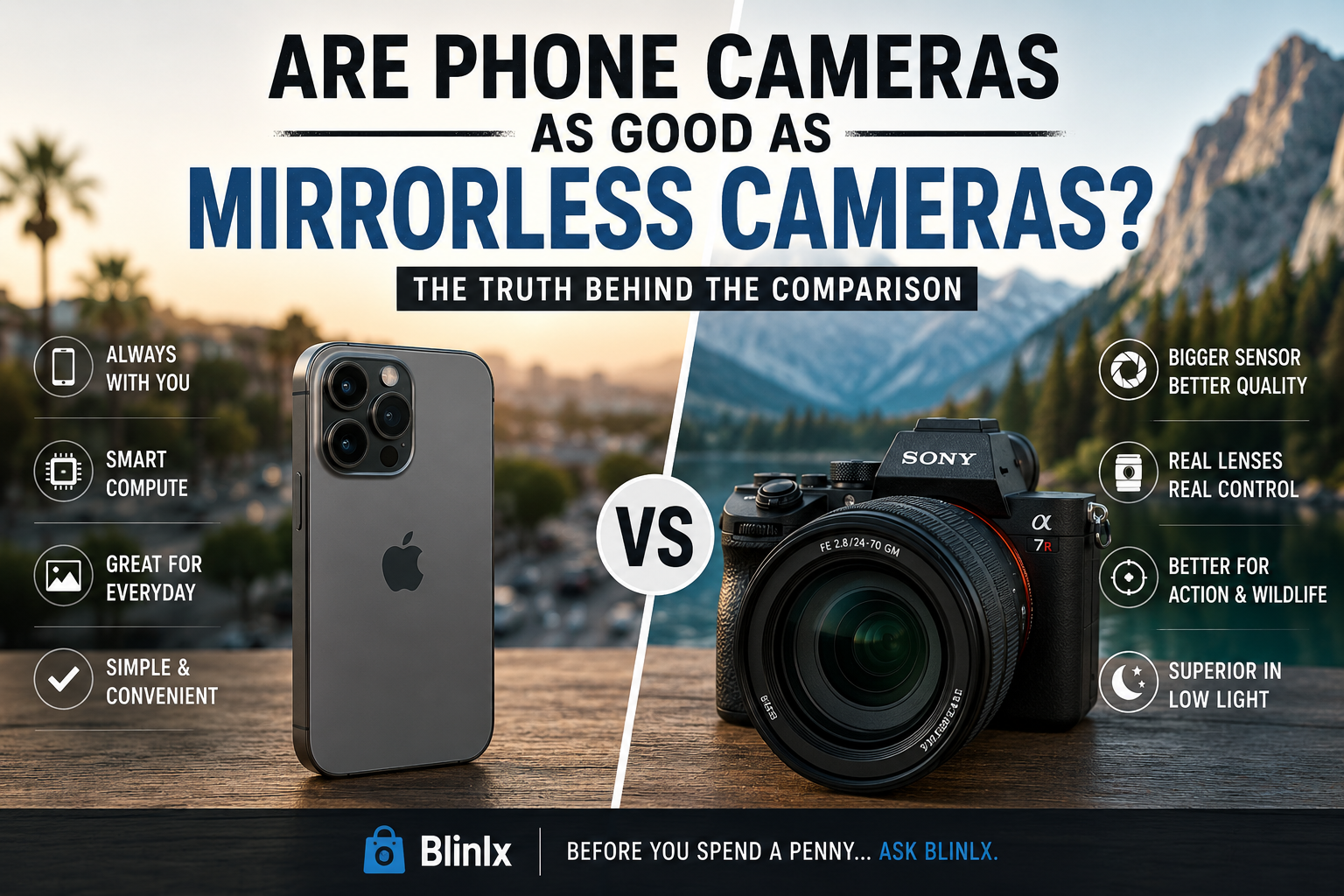
Modern flagship phones can produce astonishing photographs, but clever software and multiple tiny cameras still aren't the same thing as a dedicated mirrorless camera. Here's where phones genuinely compete — and where a proper camera still wins.
There was a time when comparing a phone camera with a mirrorless camera would have been ridiculous.
That time has gone.
The best smartphones can now produce photographs that look fantastic straight out of the camera. They automatically balance bright skies and dark shadows, recognise faces, combine several exposures, reduce noise, stabilise video and even simulate the shallow depth of field traditionally associated with larger cameras and fast lenses.
For everyday photography, the results can be remarkably good.
So good, in fact, that there's a reasonable question to ask before spending £1,000, £2,000 or considerably more on a mirrorless camera and lenses:
Do you actually need a proper camera anymore?
For a lot of people, the answer is no.
But that doesn't mean smartphones have caught mirrorless cameras in every meaningful way.
The difference is that phones have become exceptionally clever at overcoming the limitations of their small camera hardware, while mirrorless cameras start with fundamentally better photographic hardware.
And depending on what you're photographing, that distinction can matter enormously.
The Blinlx verdict
For holidays, family photographs, social media, everyday snapshots and casual video, a good modern smartphone can absolutely be all the camera many people need.
If you already own a recent flagship phone and you're considering buying a mirrorless camera simply because you assume it will automatically make your photographs better, we wouldn't rush to spend the money.
Learn to get everything you can from the phone first.
Mirrorless cameras still make much more sense for wildlife, sports, serious portraiture, low-light photography, professional work, large prints and anyone who wants genuine control over lenses, depth of field and image capture.
In other words:
Phones are getting remarkably good at making photography easy. Mirrorless cameras are still better at giving photographers possibilities.
Why phone photographs look so good now
One of the biggest mistakes in this comparison is looking only at specifications.
A phone might advertise a 48MP, 50MP or even 200MP camera, while an expensive mirrorless camera might have "only" 24 megapixels.
That doesn't mean the phone has the better camera.
Smartphones have become impressive largely because of computational photography.
When you press the shutter button, the phone may do far more than capture a single photograph.
Depending on the device and shooting mode, it can capture multiple frames and combine information from them. It can analyse faces, shadows, highlights and movement. It can apply local sharpening, noise reduction, tone mapping and colour processing almost instantly.
You press one button and receive a finished photograph.
That's incredibly powerful.
It also explains why phone images can sometimes appear more impressive than photographs straight out of a mirrorless camera.
The phone has effectively edited the picture for you.
A RAW file from a mirrorless camera may initially look flatter or less dramatic, but it contains substantially more information for the photographer to work with.
Neither approach is inherently better.
They're designed for different users.
Mirrorless cameras have one enormous physical advantage
Software can do remarkable things, but it can't completely rewrite physics.
A typical mirrorless camera sensor is dramatically larger than the sensor inside a smartphone.
Even Micro Four Thirds — one of the smaller mainstream interchangeable-lens camera formats — provides substantially more sensor area than a phone.
APS-C and full-frame sensors increase that advantage further.
Why does that matter?
Because a larger sensor can generally gather more light.
That becomes particularly important when conditions aren't perfect.
Take a photograph outdoors on a bright afternoon and the difference between a good phone and a mirrorless camera might be surprisingly difficult to spot on Instagram.
Take the same devices into a dimly lit room, photograph a moving subject and then examine the files carefully.
That's where the gap starts opening.
Phones can compensate using multi-frame processing and increasingly sophisticated noise reduction. That works extremely well when the scene allows it.
But if your subject is moving quickly, the phone doesn't always have the luxury of combining information from several perfectly aligned frames.
A larger sensor and a fast lens have a physical advantage that software has to work extremely hard to imitate.
Phones are brilliant when you don't want to think about photography
That might sound like criticism.
It isn't.
One of the greatest strengths of a smartphone camera is that it removes barriers between seeing something and photographing it.
There's no lens choice.
No camera bag.
No memory card to forget.
No debate about whether you should take the 24mm or the 50mm.
Your phone is probably already in your pocket.
You see something, pull it out and take the photograph.
For documenting family life, travel, pets, meals, nights out and all the little moments that happen unexpectedly, that convenience is incredibly difficult for a dedicated camera to beat.
The best camera really can be the one you have with you.
And a £3,000 camera sitting at home isn't particularly useful when your child does something brilliant in front of you and the only camera available is your phone.
Where mirrorless cameras are still much better
The comparison becomes very different once photography itself becomes part of the experience rather than simply recording what's happening.
Several areas still strongly favour a dedicated camera.
1. Interchangeable lenses change everything
This is arguably the biggest difference of all.
Modern phones might provide several focal lengths, typically covering some combination of ultra-wide, standard and telephoto views.
That's useful.
A mirrorless system gives you access to an entire ecosystem of lenses.
You can mount a tiny prime lens for street photography in the morning, a fast portrait lens in the afternoon and a 400mm or 600mm telephoto for wildlife later.
You can choose macro lenses, tilt-shift lenses, ultra-wide lenses and enormous-aperture primes.
More importantly, those are real optical choices, rather than digital crops or computational simulations.
If photography becomes a serious hobby, lenses are one of the main reasons a mirrorless system offers considerably more room to grow.
2. Real background blur still looks different
Portrait mode has improved enormously.
Phones can identify people and objects, estimate depth and artificially blur the background. Under the right conditions, the effect can look remarkably convincing.
But it isn't the same as optical depth of field.
Look carefully around hair, glasses, fingers and complex edges and computational blur can still make mistakes.
A larger sensor combined with something like a 50mm f/1.8 or 85mm f/1.8 creates shallow depth of field naturally.
There is no software trying to decide where the subject ends and the background begins.
The optics create the effect.
That doesn't mean every portrait needs a blurry background. But for photographers who specifically want control over depth of field, a dedicated camera remains substantially more flexible.
3. Wildlife and sports aren't really a fair fight
This is where the answer becomes much clearer.
If you're photographing birds, motorsport, football or other fast-moving subjects, we'd choose a capable mirrorless camera over a phone without hesitation.
Modern camera autofocus systems can track eyes, faces, animals, vehicles and moving subjects across the frame while shooting rapid bursts.
Combine that with a genuine telephoto lens and you can photograph subjects that would be tiny in a phone image.
Phones have increasingly impressive telephoto cameras, and they're excellent for occasional distant photographs.
But there's a substantial difference between having a phone with a telephoto option and using a 300mm, 400mm or 600mm lens designed to put a distant subject across the frame.
If wildlife or sport is the reason you're buying a camera, buy the camera.
4. Low light exposes the difference
Night modes have transformed phone photography.
A modern phone can produce handheld photographs in conditions where older compact cameras would have produced a dark, noisy mess.
That's a genuine achievement.
But again, the phone is often relying on computational techniques to overcome its hardware limitations.
Photograph a static building at night and that works beautifully.
Photograph people moving around a poorly lit venue and things become more difficult.
A mirrorless camera with a larger sensor and a bright f/1.4, f/1.8 or f/2.8 lens can capture more light in the actual exposure.
That can mean faster shutter speeds, cleaner files and better preservation of fine detail.
The darker the conditions and the more movement involved, the more useful that advantage becomes.
What about video?
This is one area where smartphones deserve enormous credit.
For casual creators, social media and family video, phones are extraordinarily capable.
You can record, stabilise, edit and publish a video from one device.
There's no transferring memory cards or carrying additional equipment.
Some phones can also record high-quality 4K footage, HDR formats and increasingly sophisticated professional video modes.
For TikTok, Instagram, YouTube Shorts and everyday video, we'd often recommend using the phone you already own before buying another camera.
Mirrorless cameras pull ahead when you need greater control.
Interchangeable lenses, larger sensors, physical aperture control, external audio options, higher-quality recording formats and more deliberate handling can make them much better tools for serious filmmaking.
But there's an important lesson here:
Don't buy a mirrorless camera because somebody told you that you need one to start creating video.
You probably don't.
Start creating first.
Upgrade when your phone becomes the thing limiting what you're trying to achieve.
Can you tell the difference on Instagram?
Often, no.
And that's worth saying.
Take a well-lit photograph with a modern flagship smartphone, resize it and display it on a social media feed viewed on another phone.
A mirrorless camera costing thousands of pounds might not produce an immediately obvious improvement.
That's partly because you're looking at a relatively small image after processing and compression.
The differences become more obvious when you crop heavily, edit RAW files, photograph difficult subjects, print large or work in challenging lighting.
This is why buying a dedicated camera purely because you expect every photograph to suddenly look dramatically better can lead to disappointment.
The camera gives you more capability.
You still have to use it.
A mirrorless camera won't automatically make you a better photographer
This is perhaps the most important point in this entire guide.
Photography is still photography.
Composition matters.
Light matters.
Timing matters.
Understanding your subject matters.
A photographer who understands those things can make an exceptional image with a phone.
Someone who doesn't won't magically start producing great photographs because they bought an expensive full-frame camera.
In fact, phones can be fantastic learning tools because they're always available.
Try photographing the same scene from different heights.
Watch how light changes throughout the day.
Experiment with foreground elements, reflections, shadows and framing.
Move closer rather than immediately zooming.
Those skills transfer directly to a dedicated camera if you eventually buy one.
Should you buy a mirrorless camera if you already own a good phone?
Ask yourself what your phone cannot currently do.
That's a much better question than asking whether a mirrorless camera is technically better.
If your answer is:
"Nothing really — I just thought a proper camera might take better pictures."
Keep your money for now.
If your answer is:
"I want to photograph birds but can't get close enough."
A mirrorless camera and telephoto lens could transform what you're able to photograph.
If it's:
"I want natural shallow-depth-of-field portraits."
A camera with a suitable portrait lens makes sense.
Or:
"My children play sport and my phone struggles to capture them moving."
Again, that's a genuine reason to consider a dedicated camera.
The upgrade should solve an actual photographic problem.
That's how we'd approach the buying decision.
Phone vs mirrorless camera: which should you choose? What you photograph Our choice Everyday life Phone Family snapshots Phone Social media Phone Holidays and casual travel Phone for most people Street photography Either Portrait photography Mirrorless Wildlife Mirrorless Sports Mirrorless Serious low-light photography Mirrorless Large prints Mirrorless Casual video Phone Professional video production Mirrorless Learning photography Either — start with what you own
There isn't one winner because the two devices increasingly solve different problems.
Don't underestimate the cost of a camera system
There's another reason we wouldn't automatically tell everyone to buy mirrorless.
The camera body is only the beginning.
Once you enter an interchangeable-lens system, it's very easy for £1,000 to become £2,000.
You might eventually want another lens, spare batteries, memory cards, a camera bag, filters, a tripod, cleaning equipment and perhaps a flash.
That can be worthwhile if photography is something you genuinely enjoy.
But if your photographs mostly end up in family WhatsApp groups and on Instagram, ask whether that investment will actually improve your experience.
Sometimes the smarter purchase isn't another camera.
Sometimes it's no purchase at all.
The gap is shrinking — but it's shrinking in a strange way
Phone cameras will continue improving.
Sensors will get better. Processing will become more sophisticated. Computational depth mapping will improve. AI-assisted image processing will become increasingly capable of recognising what photographers are trying to achieve.
But mirrorless cameras are improving too.
Autofocus is becoming astonishingly capable. Sensors are getting faster. Video specifications continue advancing. Computational features are beginning to appear in dedicated cameras as well.
So we're unlikely to reach a simple moment when everyone declares:
"Phones have beaten cameras."
Instead, phones will continue making dedicated cameras unnecessary for more people.
That's already happened.
Compact point-and-shoot cameras were once everywhere. Smartphones consumed much of that market because they were more convenient and eventually became good enough.
Mirrorless cameras increasingly serve the people who want something their phone can't provide.
And that's actually a healthier way to think about them.
Blinlx says: don't buy a camera until your phone gives you a reason
If you've got a good smartphone and you're curious about photography, start there.
Take thousands of photographs.
Learn composition.
Learn to recognise good light.
Discover what you actually enjoy photographing.
Eventually you may encounter something frustrating.
Maybe you can't get close enough to wildlife.
Maybe your indoor photographs of moving subjects are consistently poor.
Maybe you want more natural control over depth of field.
Maybe you want to print your work.
Maybe you've simply fallen in love with photography and want the experience of controlling a camera yourself.
That's when a mirrorless camera starts making sense.
Not because phones are bad.
Quite the opposite.
Phone cameras have become so good that buying a dedicated camera should now have a purpose.
For millions of people, a smartphone genuinely is all the camera they'll ever need.
For photographers who want to go beyond its limitations, however, a mirrorless camera still opens doors that even the cleverest computational photography can't completely reproduce.
Before you spend a penny…
Ask yourself one question:
What photograph am I trying to make that my phone currently won't let me make?
If you don't have an answer yet, keep shooting with your phone.
If you do, that's when Blinlx can help you find the camera and lens that actually solves the problem.