Buying Advice
Sony Camera System vs Canon Camera System: Which Should You Choose?
Sony and Canon both make exceptional mirrorless cameras, but choosing between them means buying into an entire system of bodies, lenses and future upgrades. We break down where each system shines and which photographers each one makes the most sense for.
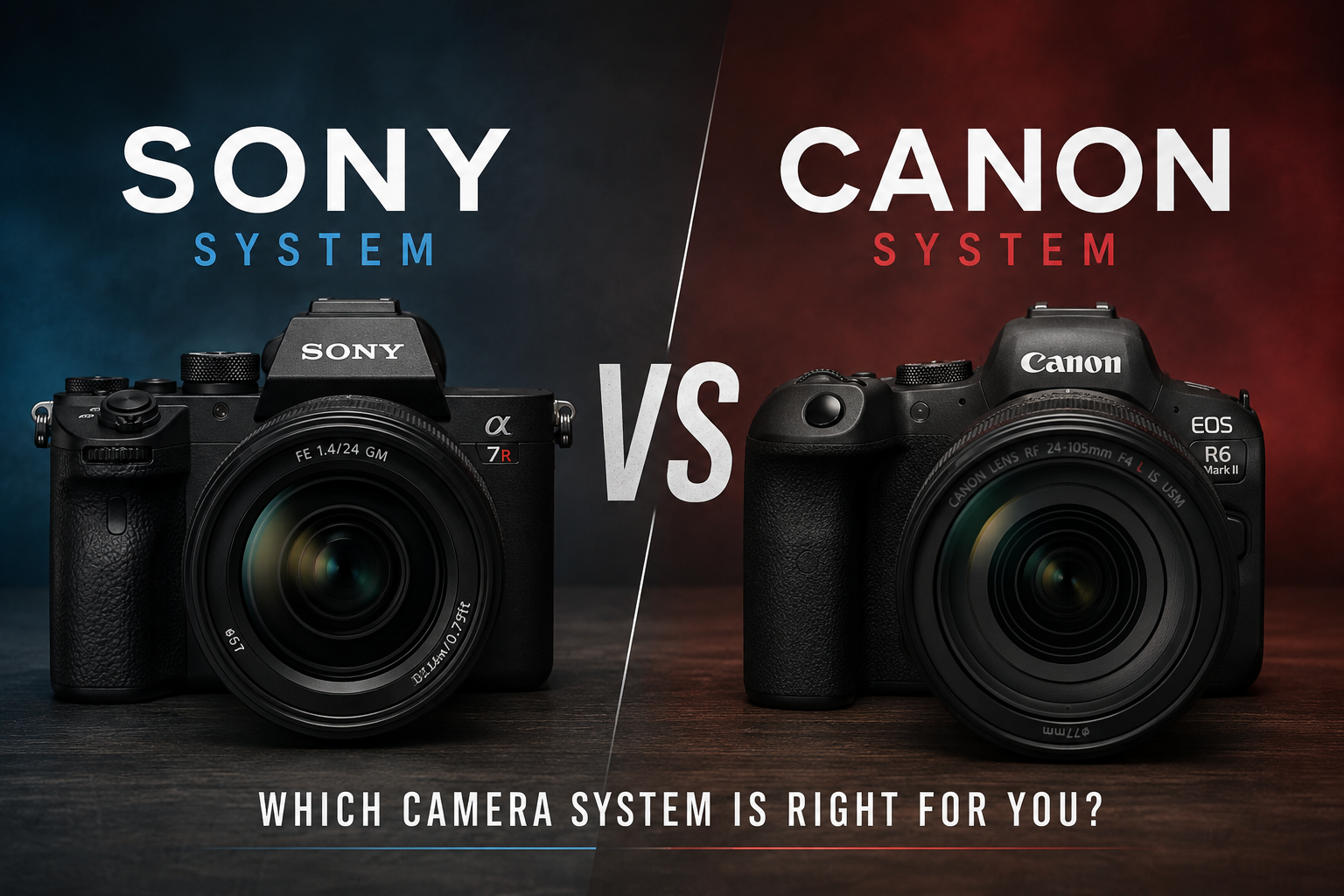
Choosing between Sony and Canon isn't really about choosing a camera.
It's about choosing a camera system.
The body you buy today might be replaced in three or four years, but the lenses you collect along the way could stay in your bag for considerably longer. Once you've invested in several lenses, batteries, accessories and perhaps a second body, changing brands becomes a much bigger decision.
That's why asking whether Sony or Canon makes the "best camera" isn't particularly useful.
Both companies make excellent cameras.
The better question is:
Which camera system makes the most sense for you?
Sony and Canon have taken different routes into the modern mirrorless era, and those differences still influence what photographers can buy today.
Sony has built an enormous E-mount ecosystem with cameras ranging from relatively affordable APS-C bodies to high-resolution professional full-frame models. Its lens selection has also benefited from years of support from third-party manufacturers.
Canon's RF system is newer, but Canon has developed an increasingly broad range of cameras and lenses covering beginners, enthusiasts and working professionals.
Either system can produce exceptional photographs.
But depending on what you photograph, your budget and how you expect your equipment to grow, one may make considerably more sense than the other.
The Most Important Thing: You're Buying a System
It's very easy to concentrate entirely on the camera body when buying your first mirrorless camera.
That makes sense.
The camera is the exciting part.
It's the thing with the new autofocus system, impressive burst rate, high-resolution sensor and enormous specification sheet.
But camera bodies are temporary.
Lenses are often long-term investments.
Buy a Sony E-mount camera and you're entering Sony's lens ecosystem.
Buy a Canon RF camera and you're entering Canon's.
Your next lens, second camera body and future upgrade are all likely to be influenced by that first decision.
That's why we think the lens system deserves just as much attention as the camera itself.
A slightly better camera body isn't necessarily the better purchase if the other system offers lenses that suit your photography and budget more effectively.
Sony's Biggest Strength: Choice
One of Sony's greatest advantages is the maturity of the E-mount system.
Sony entered the full-frame mirrorless market early and has had years to expand both its camera range and lens ecosystem.
That matters because photographers aren't limited to Sony's own lenses.
Depending on the focal length and camera format, buyers can find lenses from manufacturers including Sigma, Tamron, Samyang and others alongside Sony's own range.
That creates something extremely valuable:
Choice.
You might want a premium Sony G Master lens.
You might prefer a smaller lens for travelling.
You might want a third-party alternative that delivers excellent performance while costing considerably less.
Having multiple manufacturers building lenses for the same mount can give buyers more ways to build a kit around their actual budget.
For photographers who enjoy researching lenses and putting together a system piece by piece, Sony's ecosystem is particularly attractive.
Canon's Biggest Strength: A Very Coherent System
Canon's RF system approaches things somewhat differently.
Canon produces cameras ranging from accessible APS-C models through enthusiast full-frame bodies and into professional equipment.
The RF lens range has also grown substantially, covering inexpensive everyday lenses as well as specialist professional optics.
What Canon often does particularly well is make the camera and lens experience feel like parts of the same system.
Controls, autofocus behaviour, menus and lens integration can make moving between Canon bodies feel familiar.
That can be particularly valuable to photographers who already have experience with Canon equipment.
Someone moving from a Canon DSLR may find the transition to an EOS R-series mirrorless camera relatively natural.
There is also a huge amount of Canon photography equipment already in circulation.
For existing Canon photographers, that history matters.
A photographer isn't necessarily starting from zero just because they're moving to mirrorless.
Sony vs Canon Lenses
This is arguably more important than comparing camera specifications.
Sony E-mount currently offers an enormous variety of lenses across both APS-C and full-frame cameras.
There are compact primes, affordable zooms, premium professional lenses, specialist optics and numerous third-party alternatives.
That variety can be especially useful when working with a limited budget.
Suppose two photographers each have £2,000 to build a complete camera kit.
The question isn't simply which £1,500 camera is better.
The real question is what camera and lens combination each photographer can build for £2,000.
That can produce a completely different answer.
Canon's RF lens system also covers a wide range of needs, and Canon has produced some extremely ambitious professional lenses alongside smaller and more affordable options.
The right choice therefore depends heavily on what lenses you expect to need.
Before buying either system, we'd recommend looking beyond the kit lens.
Ask yourself what your second and third lenses are likely to be.
Then look at what those lenses actually cost.
That exercise can tell you more about which system suits you than comparing two camera bodies ever will.
What About APS-C?
Both Sony and Canon offer APS-C mirrorless cameras.
These smaller-sensor cameras can make a lot of sense for beginners, travellers and photographers who want smaller or less expensive equipment.
Sony's APS-C E-mount cameras benefit from sharing the broader E-mount ecosystem.
A photographer can use compatible full-frame E-mount lenses on an APS-C Sony body, which can provide useful flexibility when building towards a future full-frame kit.
Sony also has a long-established APS-C camera line.
Canon's RF-S cameras provide another route into the EOS R system.
Models in this part of Canon's range can offer an accessible starting point for photographers who don't need full-frame equipment.
But again, we'd look at the system rather than just the body.
If you plan to stay with APS-C for years, investigate the lenses you actually want.
If you expect to move to full frame later, consider how much of your initial kit could move with you.
The cheapest route into a system isn't always the cheapest route over five years.
Autofocus: Both Systems Are Extremely Capable
Autofocus used to be an area where choosing between camera brands could produce dramatic differences.
Today the gap is much smaller at many price points.
Modern Sony and Canon mirrorless cameras can offer sophisticated subject detection, eye detection and continuous autofocus capabilities.
The exact performance varies between individual models, of course.
A flagship sports camera shouldn't be compared directly with an entry-level body simply because they share the same logo.
That's why we'd avoid saying "Sony autofocus is better" or "Canon autofocus is better" as a blanket statement.
Compare the actual cameras you're considering.
For most people buying a modern mid-range camera from either system, autofocus is likely to be extraordinarily capable compared with cameras from only a few generations ago.
Sports, wildlife and action photographers should pay closer attention to the individual body because tracking behaviour, burst rates, sensor readout and buffer performance can become much more important.
Image Quality Isn't a Good Reason to Pick a Side
If you're hoping we'll declare that one brand simply produces better photographs, we're going to disappoint you.
Both systems are capable of outstanding image quality.
Sensor resolution, dynamic range, noise performance and colour can differ between individual cameras, but modern cameras from Sony and Canon are capable of professional results.
The photographer, lens, light and processing will usually matter considerably more than the badge on the front of the camera.
That's particularly true when comparing cameras at similar price points and from similar generations.
Don't choose an entire camera system because somebody on the internet prefers one company's colours.
Look at the complete package.
Sony vs Canon for Video
Video is another area where individual camera models matter much more than brand loyalty.
Both Sony and Canon now produce cameras with serious video capabilities.
Depending on the model, that can include high-resolution recording, high frame rates, log profiles, sophisticated autofocus and advanced stabilisation features.
But video buyers need to look deeper than the headline resolution.
Recording limits, overheating behaviour, rolling shutter, crop factors, codecs, stabilisation and connection options can all affect whether a camera actually works for a particular production.
Someone recording occasional family videos has completely different requirements from a wedding filmmaker.
And a YouTube creator has different requirements again.
If video is your priority, choose between specific bodies rather than choosing Sony or Canon first and trying to justify the camera afterwards.
Sony for Wildlife and Sports
Sony has some extremely capable cameras for action, sports and wildlife photography.
Fast autofocus, subject recognition, high-speed bodies and a substantial selection of telephoto lenses make E-mount a serious option for these photographers.
But the body is only half the equation.
Wildlife photography in particular can become extremely expensive once long lenses are involved.
This is where comparing complete kits becomes essential.
Don't ask:
How much is the camera?
Ask:
How much is the camera plus the lens I actually need?
A cheaper body paired with the right telephoto lens could be a far better wildlife setup than spending most of the budget on an expensive camera and compromising heavily on glass.
Canon for Wildlife and Sports
Canon is equally serious about action photography.
The EOS R system includes bodies designed for demanding autofocus and burst shooting, while Canon's RF telephoto range extends from more accessible options through to specialist professional lenses.
Canon has also traditionally had a very strong presence in professional sports photography.
For somebody already owning compatible Canon equipment, remaining within the Canon ecosystem may make considerably more financial sense than starting again with another brand.
That's an important point that specification comparisons frequently ignore.
The best system for a new photographer and the best system for somebody who already owns £4,000 of lenses may be completely different.
What If You Already Own Canon DSLR Lenses?
This can dramatically change the decision.
If you've spent years building a collection of Canon EF lenses, don't automatically assume you need to sell everything because you've decided to move to mirrorless.
Canon's EF-to-RF adaptation options can make existing EF lenses relevant when moving into the RF system.
Exactly what makes sense depends on the lenses you own and the camera you're considering, but existing equipment has real financial value.
Switching to Sony might still make sense.
But it should offer enough benefit to justify potentially replacing a substantial amount of equipment.
Brand switching is easy when you own one camera and one inexpensive lens.
It's a very different proposition when you've spent ten years building a professional kit.
What If You're Starting From Nothing?
This is where Sony becomes particularly compelling.
A new photographer doesn't have legacy equipment influencing the decision.
That means you can evaluate each ecosystem purely on what it offers today.
Sony's broad E-mount lens selection gives a new buyer an enormous number of possible kit combinations.
You can start modestly and build gradually.
Third-party lenses can also provide alternatives at different price points.
Canon remains a very strong choice, particularly if you prefer Canon's cameras, ergonomics or particular RF lenses.
But somebody starting with absolutely no equipment should spend serious time comparing the lens roadmap for their budget before choosing either system.
Your first camera might cost £1,000.
Over the next several years, your lenses could cost considerably more.
Ergonomics Matter More Than People Admit
Specifications are easy to compare online.
Comfort isn't.
A camera can have the best specifications in its class and still be the wrong camera for you if you dislike using it.
Grip shape, button placement, viewfinder position, menu design and even the way a shutter button feels can influence the experience.
This is an area where personal preference matters enormously.
Some photographers love Canon's ergonomics.
Others prefer Sony.
Neither person is wrong.
If you're about to spend a significant amount of money, try to hold both cameras before buying if possible.
Ten minutes in a camera shop can sometimes tell you something that three hours of YouTube comparisons can't.
Don't Ignore the Secondhand Market
This is becoming increasingly important.
You don't necessarily need the newest Sony or Canon camera.
Previous-generation bodies can represent exceptional value, particularly for photographers whose requirements don't depend on the latest autofocus or video features.
The same applies to lenses.
A carefully chosen used lens can allow you to buy substantially better glass without increasing your overall budget.
This is one reason we don't think camera recommendations should focus exclusively on products currently sitting at the top of a manufacturer's website.
A £1,000 budget should be treated as £1,000 to build the best photographic setup possible.
Not £1,000 that must be spent on something released this year.
Sometimes the smartest Sony purchase is an older Sony.
Sometimes the smartest Canon purchase is an older Canon.
And sometimes the smartest purchase is keeping your current camera and buying a better lens.
Which System Is Better for Beginners?
There's no universal winner.
A beginner who wants maximum flexibility when choosing affordable lenses may find Sony particularly attractive.
Another beginner might strongly prefer the handling and interface of a Canon camera.
Price also changes everything.
A heavily discounted Canon body could make far more sense than a Sony at its normal price.
A strong secondhand Sony deal could reverse that decision.
Instead of asking which brand is best for beginners, we'd ask:
What do you want to photograph?
What's your total budget including a lens?
How important are size and weight?
Do you expect to buy more lenses?
Are you interested in video?
Do you expect to move to full frame?
Those answers are much more useful than the logo on the camera.
Which Would We Choose?
If we were starting completely from scratch, Sony's enormous E-mount ecosystem would be very difficult to ignore.
The sheer amount of lens choice gives photographers considerable freedom to build a system around different budgets.
That doesn't mean we'd automatically buy Sony.
If a Canon body suited our photography better, felt substantially better to use, or Canon offered the particular lenses we wanted at sensible prices, we'd happily choose Canon.
And if we already owned several good Canon EF lenses, we'd think very carefully before abandoning that investment.
That's the important distinction.
We're not trying to pick a winner for everyone.
We're trying to identify the better buying decision for the individual photographer.
The Blinlx Verdict
Sony and Canon are both mature, highly capable mirrorless camera systems.
Neither is going to prevent you from producing excellent photographs.
Sony's biggest advantage is choice.
Its established E-mount ecosystem, extensive camera range and broad lens selection — including many third-party options — make it exceptionally flexible for somebody building a kit from scratch.
Canon's RF system offers an increasingly broad range of cameras and lenses, strong integration across the system and a particularly logical upgrade path for many existing Canon photographers.
If you're choosing between them, don't begin by asking which company makes the best camera.
Start with your photography.
Work out what you shoot.
Decide what lenses you'll realistically need.
Set a total budget for the camera and those lenses.
Consider what you might want to buy in two or three years.
And if you already own equipment, include the cost of replacing it in the decision.
Then choose the system that makes the most sense.
Because the best camera system isn't Sony.
And it isn't Canon.
It's the one that gives you the equipment you actually need without making you spend money on things you don't.