
The Complete Black and White Photography Buying Guide
Independent Blinlx buying advice for black and white photography equipment including the products, features, trade-offs and buying mistakes that matter.
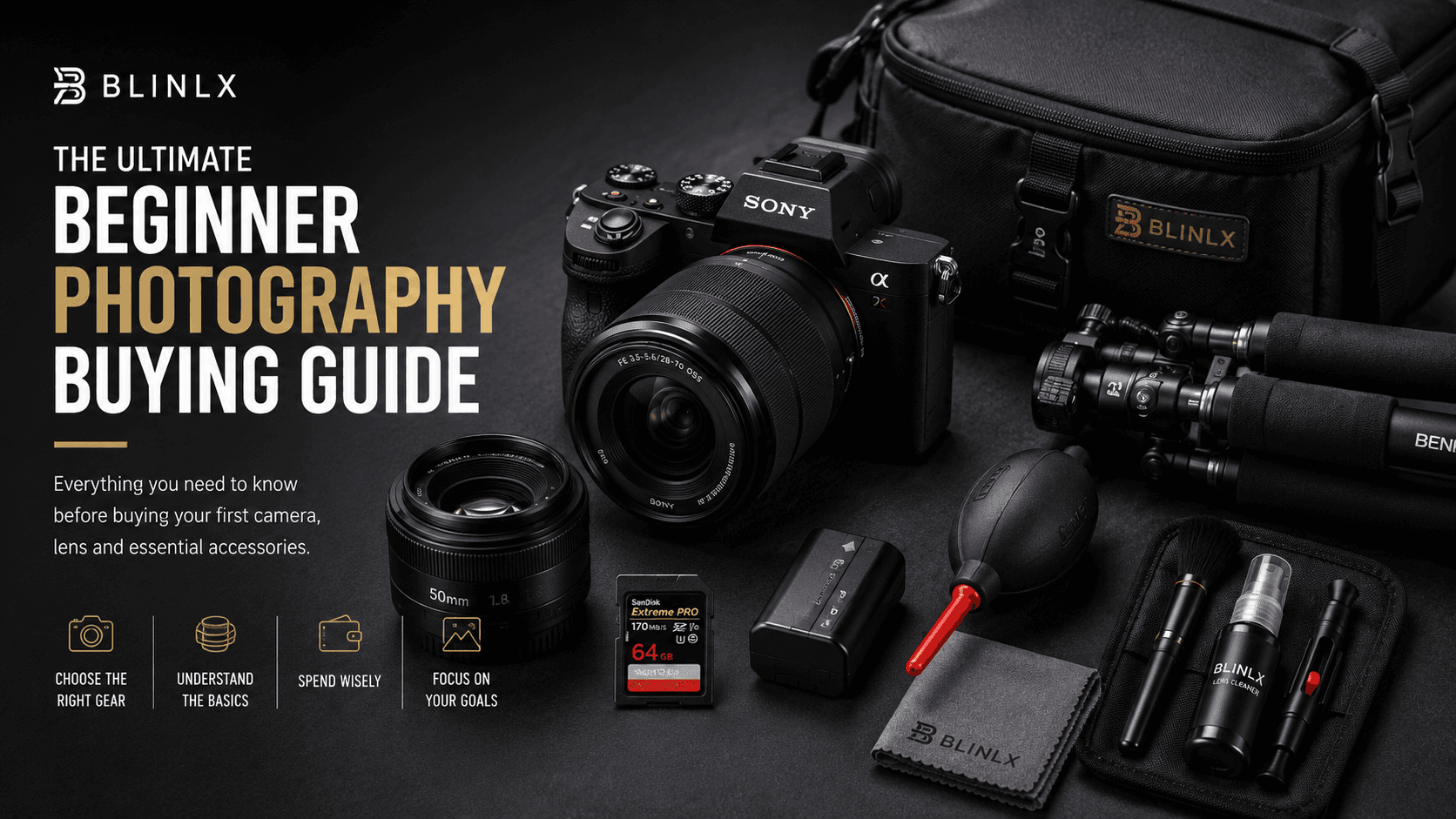
Blinlx verdict
The Blinlx Verdict
If it were our money, Sony A6400 would be the current starting point because the Sony A6400 is strongest when autofocus reliability, compact size and lens availability matter more than in-body stabilisation or the newest video features. It can be especially attractive used, provided the physical condition, shutter use, battery condition and seller protection are checked carefully. When buying new, compare its price with newer Sony APS-C bodies because the A6400 only represents strong value when the saving is meaningful. We would choose differently if no in-body image stabilisation would interfere with the main use. We would only spend more when the additional cost removes a limitation we would genuinely notice.
- The useful cost includes the body, lens, memory card, battery, storage and any accessories required for the intended photography.
- Access to a broad range of Sony and third-party E-mount lenses.
- A strong balance of image quality, portability and system cost. The compromise is less low-light flexibility and depth-of-field control than full frame at equivalent framing and aperture. This trade-off is most likely to make sense for beginners, travel photographers, family photographers, enthusiasts wanting a smaller system.
Blinlx buying intelligence
🧠 What Blinlx Thinks
If we were buying today, Sony A6400 would be our current starting point for beginner photographers who want reliable autofocus because reliable autofocus with strong face, eye and subject tracking.
If it was our money
If it were our money, Sony A6400 would be the current starting point because the Sony A6400 is strongest when autofocus reliability, compact size and lens availability matter more than in-body stabilisation or the newest video features. It can be especially attractive used, provided the physical condition, shutter use, battery condition and seller protection are checked carefully. When buying new, compare its price with newer Sony APS-C bodies because the A6400 only represents strong value when the saving is meaningful. We would choose differently if no in-body image stabilisation would interfere with the main use. We would only spend more when the additional cost removes a limitation we would genuinely notice.
Why
- Reliable autofocus with strong face, eye and subject tracking.
- Compact body with strong image quality from its 24.2-megapixel APS-C sensor.
- Access to a broad range of Sony and third-party E-mount lenses.
- Continuous shooting at up to 11 frames per second is useful for children, pets and moderate action.
Things to keep in mind
- No in-body image stabilisation.
- The older NP-FW50 battery is relatively small, so a spare battery is sensible.
- The menu and control layout can take time to learn.
- The compact grip may feel cramped with larger lenses.
- The screen tilts upward rather than opening fully to the side.
Quick summary
- The useful cost includes the body, lens, memory card, battery, storage and any accessories required for the intended photography.
- Access to a broad range of Sony and third-party E-mount lenses.
- A strong balance of image quality, portability and system cost. The compromise is less low-light flexibility and depth-of-field control than full frame at equivalent framing and aperture. This trade-off is most likely to make sense for beginners, travel photographers, family photographers, enthusiasts wanting a smaller system.
- A strong choice for travel, family, street and everyday photography.
Chapter One
The Blinlx Way
Every recommendation we make is guided by three principles designed to protect your money and help you buy with confidence.
Blinlx knowledge
Trust Before Profit
Blinlx should always prioritise the buyer’s best interests over affiliate commission, sponsorship value or short-term revenue.
Every Blinlx recommendation should begin with one question: if this were our money, what would we genuinely choose?
A product or retailer should never be recommended simply because it pays a higher commission.
When a cheaper product is the better choice, Blinlx should recommend the cheaper product.
When waiting is likely to produce better value, Blinlx should tell the buyer to wait.
When no available option is worth buying, Blinlx should be willing to recommend buying nothing.
Long-term user trust is more valuable than a short-term affiliate conversion.
Blinlx knowledge
Buy for Your Needs
The best product is the one that matches the buyer’s real needs, priorities and budget—not the product with the longest specification sheet.
Every buying decision should begin with the intended use rather than the available products.
A product with fewer premium features may still be the better choice when those features do not improve the buyer’s real experience.
Buyers should avoid paying for performance, capacity or capability they are unlikely to use.
Budget should be considered alongside the full setup cost, including accessories, subscriptions, maintenance and future upgrades.
A suitable product should solve the buyer’s actual problem without creating unnecessary expense or complexity.
Blinlx should recommend the simplest product that confidently meets the buyer’s current and reasonably expected future needs.
Blinlx knowledge
Buy for Longevity
A strong purchase should remain useful, supported and suitable for long enough to justify its total cost.
The cheapest product today is not always the least expensive product to own.
Buyers should consider expected lifespan, software support, repairability, durability and future performance before deciding.
A product that costs slightly more but remains useful for several additional years can provide significantly better long-term value.
Future needs should be considered realistically, without paying for extreme capability that is unlikely to be used.
Blinlx should favour products that balance current suitability with dependable long-term ownership.
Our recommendations
Sony E 18-135mm F3.5-5.6 OSS
The Sony E 18-135mm F3.5-5.6 OSS is one of the most practical single-lens choices for Sony APS-C photographers. It makes particular sense for travel, family and everyday photography where flexibility and low carrying weight matter more than a bright constant aperture. Choose it over the 16-50mm kit lens when additional reach and stronger overall performance justify the larger size; choose a constant-aperture zoom or specialist telephoto when low-light capability or maximum image quality matters more The main compromise is the variable f/3.5–5.6 aperture becomes relatively slow toward the telephoto end.
- The broad 18–135mm focal range covers landscapes, everyday photography, portraits, travel and moderate telephoto subjects without frequent lens changes.
- Its 27–202.5mm full-frame-equivalent range makes it considerably more versatile than a standard kit zoom.
- Optical SteadyShot stabilisation helps reduce camera shake when shooting handheld.
Canon RF-S 18-45mm F4.5-6.3 IS STM
The Canon RF-S 18-45mm F4.5-6.3 IS STM is a sensible first lens for EOS R50 and EOS R10 buyers who value compact size, low weight and straightforward everyday flexibility. It is strongest when included in an attractively priced camera kit. Choose it for travel, family and general photography; consider the RF-S 18-150mm when greater reach and one-lens convenience justify the extra size and cost The main compromise is the variable f/4.5–6.3 aperture limits low-light performance and background separation.
- The retractable design keeps compatible Canon APS-C camera kits exceptionally compact.
- Its 130-gram weight makes it easy to carry for travel, family occasions and everyday photography.
- The 18–45mm range provides a useful 29–72mm full-frame-equivalent field of view on Canon APS-C cameras.
Canon RF 50mm F1.8 STM
The Canon RF 50mm F1.8 STM is one of the easiest native RF lenses to recommend because it adds genuine low-light capability and background separation without a large financial or physical commitment. It is especially useful as an affordable portrait lens on the EOS R50, R10 and R7, where it provides an approximately 80mm-equivalent view. Full-frame users gain a compact natural-perspective prime for everyday photography. Choose it when aperture and subject separation matter more than zoom flexibility, but remember that its field of view can feel restrictive indoors on an APS-C camera The main compromise is the fixed 50mm focal length is less flexible than a zoom lens.
- The bright f/1.8 aperture provides substantially stronger low-light capability than typical Canon kit zooms.
- It can create attractive background separation and shallow depth of field for portraits and detail photography.
- The compact 160-gram design is easy to carry and balances well with small Canon EOS R bodies.
NIKKOR Z DX 16-50mm F3.5-6.3 VR
The NIKKOR Z DX 16-50mm VR is one of the best kit lenses currently available. Its tiny size, excellent sharpness and optical stabilisation make it a superb everyday companion for Nikon DX cameras The main compromise is variable maximum aperture.
- Extremely compact and lightweight.
- Excellent image quality for a kit lens.
- Very sharp throughout much of the zoom range.
NIKKOR Z DX 50-250mm F4.5-6.3 VR
The NIKKOR Z DX 50-250mm VR is one of the best-value telephoto lenses available for Nikon DX cameras. Combined with the 16-50mm VR it creates an affordable, lightweight system covering almost every everyday photographic situation The main compromise is variable aperture limits low-light performance.
- Excellent value telephoto zoom.
- Very sharp throughout most of the zoom range.
- Useful 75-375mm equivalent reach.
Introduction
The useful cost includes the body, lens, memory card, battery, storage and any accessories required for the intended photography.
Access to a broad range of Sony and third-party E-mount lenses.
A strong balance of image quality, portability and system cost. The compromise is less low-light flexibility and depth-of-field control than full frame at equivalent framing and aperture. This trade-off is most likely to make sense for beginners, travel photographers, family photographers, enthusiasts wanting a smaller system.
Define what you want the purchase to help you achieve before comparing individual products.
Do You Actually Need black and white photography equipment?
Do not buy until you can describe the specific problem the new purchase will solve.
Who Is black and white photography equipment For?
A strong choice for travel, family, street and everyday photography.
Match the product to your normal use rather than choosing the option designed for the most demanding buyer.
What Should You Look For?
Reliable autofocus with strong face, eye and subject tracking.
The Sony A6400 uses the Sony NP-FW50 rechargeable battery.
Write down the three requirements that matter most and remove any option that fails one of them.
How Much Should You Spend?
It can offer particularly strong value when bought used in good condition.
Include every essential accessory and supporting cost before deciding how much is available for the main product.
Common Buying Mistakes
You need in-body image stabilisation.
You mainly shoot handheld video and want modern stabilisation features.
You regularly use large or heavy lenses.
You want the simplest possible menu system.
Before paying, check that the decision is based on your needs rather than popularity, urgency or a headline discount.
Our Recommended Options
Sony A6400 deserves consideration because the Sony A6400 is strongest when autofocus reliability, compact size and lens availability matter more than in-body stabilisation or the newest video features. It can be especially attractive used, provided the physical condition, shutter use, battery condition and seller protection are checked carefully. When buying new, compare its price with newer Sony APS-C bodies because the A6400 only represents strong value when the saving is meaningful. It is particularly well suited to beginner photographers who want reliable autofocus. Its biggest strength is reliable autofocus with strong face, eye and subject tracking. The main compromise is no in-body image stabilisation.
Shortlist only the products whose strengths match your intended use and whose weaknesses you can comfortably accept.
Alternatives Worth Considering
An older-generation step up that adds in-body image stabilisation, a larger battery and a deeper grip.
Compare the obvious purchase with at least one cheaper route and one genuinely different alternative.
Before You Spend a Penny
A Sony E-mount APS-C lens compatible with the A6400.
A newer Sony body is available for only a small additional cost.
The complete setup cost leaves too little budget for an appropriate lens.
To avoid the most common mistakes when buying black and white photography equipment, turn each warning into a practical check before paying. Confirm that the option suits the intended use, meets every essential requirement and stays within the complete budget for black and white photography equipment. A popular product or attractive discount is not enough reason to overlook a limitation that will affect normal use.
Confirm the exact variant, return protection and complete cost before spending any money.
The Blinlx Verdict
If it were our money, Sony A6400 would be the current starting point because the Sony A6400 is strongest when autofocus reliability, compact size and lens availability matter more than in-body stabilisation or the newest video features. We would choose differently if no in-body image stabilisation would interfere with the main use. We would only spend more when the additional cost removes a limitation we would genuinely notice.
Frequently asked questions
What is the best black and white photography equipment for most people?
Sony E 18-135mm F3.5-5.6 OSS is the strongest currently supported option. The Sony E 18-135mm F3.5-5.6 OSS is one of the most practical single-lens choices for Sony APS-C photographers. It makes particular sense for travel, family and everyday photography where flexibility and low carrying weight matter more than a bright constant aperture. Choose it over the 16-50mm kit lens when additional reach and stronger overall performance justify the larger size; choose a constant-aperture zoom or specialist telephoto when low-light capability or maximum image quality matters more The main compromise is the variable f/3.5–5.6 aperture becomes relatively slow toward the telephoto end.
How much should I spend on black and white photography equipment?
The useful cost includes the body, lens, memory card, battery, storage and any accessories required for the intended photography.
What should I look for when buying black and white photography equipment?
Reliable autofocus with strong face, eye and subject tracking.
Should I buy black and white photography equipment new or used?
Buying used can provide better capability for the money, but only when condition, warranty, included accessories and seller protection have been checked.
What mistakes should I avoid when buying black and white photography equipment?
You need in-body image stabilisation.
Is spending more on black and white photography equipment worth it?
The useful cost includes the body, lens, memory card, battery, storage and any accessories required for the intended photography.
Related guides
The Complete Guide to Buying Used black and white photography equipment
Independent Blinlx buying advice for used black and white photography equipment including the products, features, trade-offs and buying mistakes that matter.
Read guideThe Biggest Black and White Photography Buying Mistakes
Independent Blinlx buying advice for black and white photography equipment buying mistakes including the products, features, trade-offs and buying mistakes that matter.
Read guideBest black and white photography equipment for Beginners
Independent Blinlx buying advice for black and white photography equipment for beginners including the products, features, trade-offs and buying mistakes that matter.
Read guideBest black and white photography equipment Under £1,000
Independent Blinlx buying advice for black and white photography equipment under £1000 including the products, features, trade-offs and buying mistakes that matter.
Read guideThe Complete Portrait Photography Buying Guide
Independent Blinlx buying advice for portrait photography equipment including the products, features, trade-offs and buying mistakes that matter.
Read guideThe Complete Guide to Buying Used portrait photography equipment
Independent Blinlx buying advice for used portrait photography equipment including the products, features, trade-offs and buying mistakes that matter.
Read guideThe Complete Wildlife Photography Buying Guide
Independent Blinlx buying advice for wildlife photography equipment including the products, features, trade-offs and buying mistakes that matter.
Read guideThe Complete Guide to Buying Used wildlife photography equipment
Independent Blinlx buying advice for used wildlife photography equipment including the products, features, trade-offs and buying mistakes that matter.
Read guideBefore you spend a penny
Still unsure what to buy?
Tell Blinlx what you need, what you want to use it for and how much you want to spend. We’ll help you make a smarter buying decision.
Try asking:
“Help me choose the right black and white photography equipment for my needs and budget. My buying needs are best described as: beginner monochrome photographers.”