
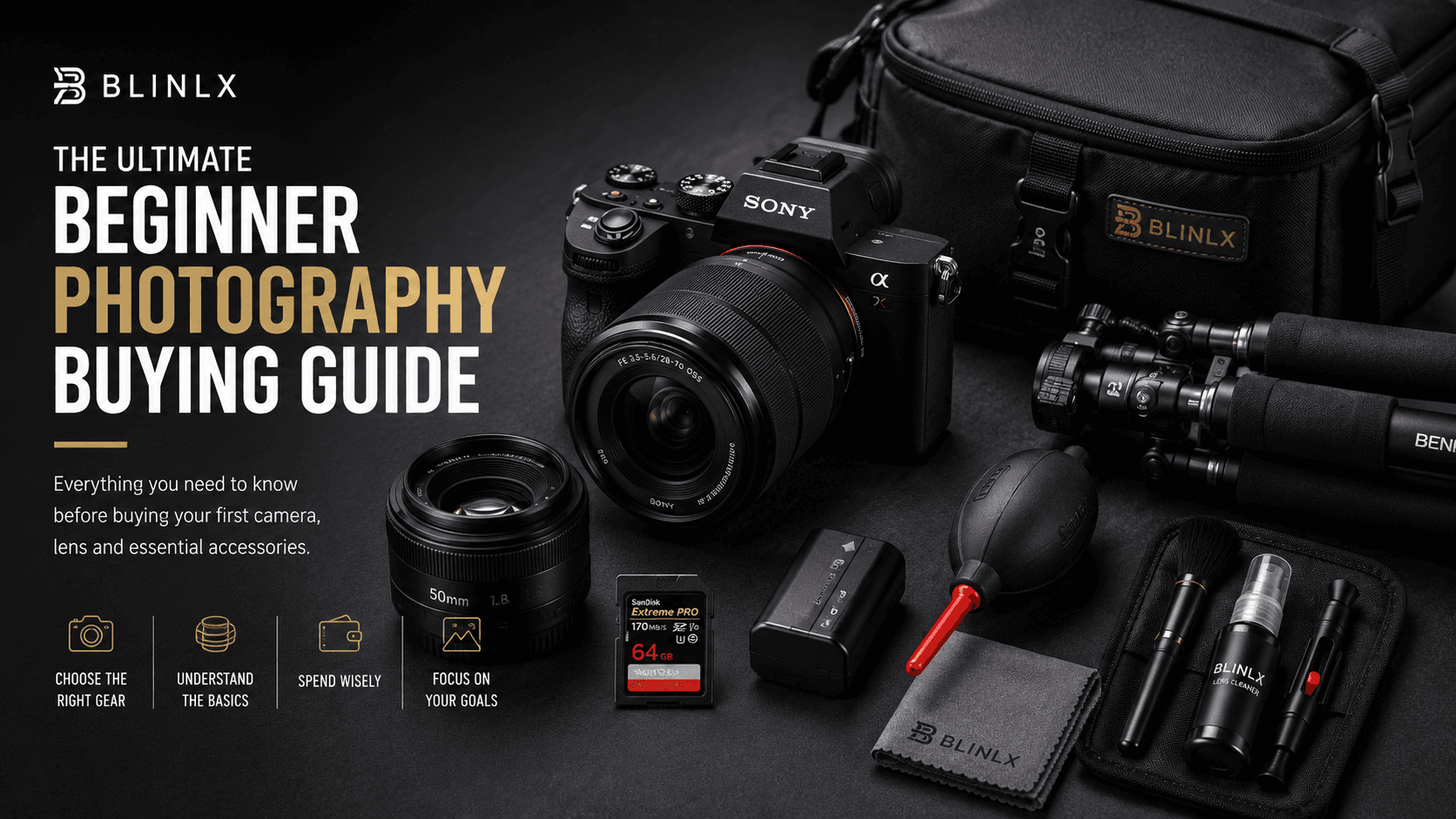
The Ultimate Beginner Photography Buying Guide (2026)
Everything you need to know before buying your first camera, lens and essential accessories.
Blinlx verdict
Choose a modern mirrorless camera and leave room in your budget for lenses.
Most beginners should prioritise ease of use, autofocus, lens availability and comfortable handling rather than chasing the highest megapixel count.
- Mirrorless cameras are the best starting point for most beginners.
- Do not spend your entire budget on the camera body.
- A useful first lens matters more than small specification differences.
- Buying used from a reputable retailer can stretch your budget further.
Blinlx buying intelligence
🧠 What Blinlx Thinks
Most beginners do not need the most powerful or expensive camera. They need a camera that is enjoyable to carry, straightforward to learn and supported by lenses that match the photography they want to explore.
If it was our money
We would buy a modern APS-C mirrorless camera, choose one useful everyday lens and keep part of the budget for a spare battery, memory card and comfortable camera bag. We would rather buy a balanced setup than spend everything on the camera body.
Why
- Modern mirrorless autofocus makes it easier for beginners to capture sharp photographs.
- APS-C cameras provide an excellent balance of image quality, size and price.
- A useful lens will influence your photography more than small differences between camera bodies.
- Keeping money aside for essential accessories prevents expensive surprises after the purchase.
Things to keep in mind
- A used DSLR may still be the better choice when the budget is extremely limited.
- Wildlife and sports photography may require more spending on lenses than general photography.
- The best camera on paper can still be the wrong choice if it feels uncomfortable in your hands.
Quick summary
- Choose the camera that fits what you want to photograph, not the one with the longest specification sheet.
- Keep part of your budget for lenses, memory cards, spare batteries and a bag.
- Try the camera in your hands before buying whenever possible.
- Around 20–30 megapixels is more than enough for most beginners.
Chapter One
The Blinlx Way
Every recommendation we make is guided by three principles designed to protect your money and help you buy with confidence.
Blinlx knowledge
Trust Before Profit
Blinlx should always prioritise the buyer’s best interests over affiliate commission, sponsorship value or short-term revenue.
Every Blinlx recommendation should begin with one question: if this were our money, what would we genuinely choose?
A product or retailer should never be recommended simply because it pays a higher commission.
When a cheaper product is the better choice, Blinlx should recommend the cheaper product.
When waiting is likely to produce better value, Blinlx should tell the buyer to wait.
When no available option is worth buying, Blinlx should be willing to recommend buying nothing.
Long-term user trust is more valuable than a short-term affiliate conversion.
Blinlx knowledge
Buy for Your Needs
The best product is the one that matches the buyer’s real needs, priorities and budget—not the product with the longest specification sheet.
Every buying decision should begin with the intended use rather than the available products.
A product with fewer premium features may still be the better choice when those features do not improve the buyer’s real experience.
Buyers should avoid paying for performance, capacity or capability they are unlikely to use.
Budget should be considered alongside the full setup cost, including accessories, subscriptions, maintenance and future upgrades.
A suitable product should solve the buyer’s actual problem without creating unnecessary expense or complexity.
Blinlx should recommend the simplest product that confidently meets the buyer’s current and reasonably expected future needs.
Blinlx knowledge
Buy for Longevity
A strong purchase should remain useful, supported and suitable for long enough to justify its total cost.
The cheapest product today is not always the least expensive product to own.
Buyers should consider expected lifespan, software support, repairability, durability and future performance before deciding.
A product that costs slightly more but remains useful for several additional years can provide significantly better long-term value.
Future needs should be considered realistically, without paying for extreme capability that is unlikely to be used.
Blinlx should favour products that balance current suitability with dependable long-term ownership.
Our recommendations
The Budget Beginner Setup
A reliable used DSLR or affordable entry-level mirrorless camera with its standard kit lens. This is the sensible starting point when learning photography without overspending.
- Keeps the initial cost under control.
- Provides everything needed to learn exposure, focus and composition.
- Leaves money available for a spare battery, memory card and camera bag.
- Can be upgraded gradually once you understand what you enjoy photographing.
The Balanced Mirrorless Setup
A modern APS-C mirrorless camera with dependable autofocus and a versatile everyday zoom lens. This is the strongest all-round choice for most beginners.
- Balances image quality, portability and price.
- Modern autofocus makes it easier to photograph people, pets and movement.
- A versatile zoom lens supports family, travel and everyday photography.
- Offers a clear upgrade path through additional lenses.
The Travel and Everyday Setup
A lightweight mirrorless camera paired with a compact zoom or small prime lens. This setup prioritises portability and makes it easier to carry the camera regularly.
- Small enough to carry on holidays and everyday outings.
- Produces excellent image quality without requiring a heavy bag.
- Suitable for family, travel, street and documentary photography.
- Encourages regular use because the complete setup remains manageable.
The Long-Term Enthusiast Setup
A higher-tier APS-C mirrorless camera with stronger controls, improved autofocus and room to grow. This suits beginners who expect photography to become a serious long-term hobby.
- Provides controls and performance that remain useful as skills develop.
- Reduces the need to replace the camera body quickly.
- Supports more demanding subjects such as wildlife, sport and action.
- Makes sense when the budget still allows for a useful lens and accessories.
Buying Your First Camera
Buying your first camera is exciting, but it can also feel overwhelming. You may be comparing mirrorless cameras, DSLRs, sensor sizes, megapixels, lenses and accessories before you have even taken your first photograph.
The goal of this guide is to help you understand what genuinely matters, where your money is best spent and which expensive beginner mistakes you can avoid.
Do You Actually Need a Camera?
Modern smartphones are exceptionally capable. For family photographs, holidays, social media and everyday memories, a phone may already deliver everything you need with far less complexity.
A dedicated camera begins to make more sense when you want stronger low-light performance, reliable subject tracking, interchangeable lenses, natural background blur, better handling or more control over the final image.
Buying a camera also creates additional costs. Lenses, memory cards, batteries, storage, bags and editing software can all become part of the real ownership price.
Before buying, be honest about whether you want better photographs, a new hobby or simply a new piece of technology. All three are valid, but they lead to different buying decisions.
Mirrorless vs DSLR
A DSLR uses a mirror and optical viewfinder, allowing you to look directly through the lens. Mirrorless cameras remove that mechanism and show a live digital preview through the screen or electronic viewfinder.
Mirrorless systems are generally smaller, offer stronger autofocus coverage and make it easier to preview exposure, white balance and depth of field before taking the photograph.
DSLRs remain attractive on tight budgets because the used market contains many excellent bodies and affordable lenses. They can still be a sensible route into photography when value matters more than owning the newest system.
For most beginners buying new, mirrorless is the safer long-term choice because manufacturers are concentrating their newest cameras, lenses and autofocus technology around mirrorless mounts.
Choose Mirrorless If You Want
Modern autofocus and intelligent subject detection.
A smaller and lighter camera system.
A live preview of exposure, colour and depth of field.
Better access to future camera and lens releases.
APS-C vs Full Frame
APS-C sensors are smaller than full-frame sensors. That allows camera bodies and lenses to be more compact and usually more affordable.
Full-frame cameras can offer improved low-light performance, greater control over shallow depth of field and stronger image quality at demanding settings, but the complete system is often larger and more expensive.
For travel, family photography, street photography and general learning, APS-C provides an excellent balance of quality, portability and price.
Full frame makes more sense when you already understand why you need it—for example, demanding low-light work, professional portraiture or a specific lens system.
Megapixels, Autofocus and Stabilisation
Around 20 to 26 megapixels is already enough for detailed photographs, large prints and generous cropping. More resolution is useful for specialist work, but it also creates larger files and greater storage demands.
Autofocus has a much bigger effect on everyday success. Face detection, eye detection and reliable subject tracking make it easier to photograph children, pets, wildlife and movement.
In-body image stabilisation can help keep photographs sharper at slower shutter speeds and makes handheld video smoother, although stabilised lenses can provide similar benefits on cameras without it.
Do not judge a camera through one headline specification. The best beginner camera is the one whose autofocus, controls, lens options, battery life and size work well together.
Choosing Your First Lens
Many beginners focus almost entirely on the camera body, but experienced photographers often invest more heavily in lenses. The lens controls sharpness, depth of field, low-light performance and the creative look of your photographs.
A good lens can remain part of your kit for many years, even after you upgrade your camera body.
If you have a limited budget, buying a slightly cheaper camera with a better lens is often the smarter long-term decision.
Prime Lenses vs Zoom Lenses
Prime lenses use one fixed focal length. They are often smaller, sharper and capable of wider apertures, which can help in low light and create stronger background blur.
Zoom lenses cover multiple focal lengths and offer greater flexibility. They are especially useful for beginners who are still discovering whether they enjoy portraits, landscapes, travel, wildlife or everyday photography.
Neither design is automatically better. The right choice depends on whether you value maximum image quality and simplicity or the flexibility to frame different subjects without changing lenses.
How Much Should You Spend?
Recommended Budget Guide
| Budget | What to Expect |
|---|---|
| Under £500 | Excellent used cameras or entry-level mirrorless kits. |
| £500–£1,000 | The sweet spot for most beginners with room for accessories. |
| £1,000–£2,000 | Enthusiast cameras with better autofocus and lenses. |
| £2,000+ | Professional equipment if you genuinely need the extra performance. |
For most beginners, the £500–£1,000 range offers the best balance between quality, features and value for money.
Instead of spending every penny on the newest camera body, keep part of your budget for a quality memory card, spare battery, comfortable camera bag and eventually another lens.
Photography is a complete system rather than a single purchase. A balanced setup will almost always outperform an expensive camera body paired with poor accessories.
The 10 Biggest Beginner Photography Mistakes
Every photographer has made at least one expensive mistake when starting out. The good news is that you don't have to repeat them.
Avoiding these common pitfalls will save you money, reduce frustration and help you enjoy photography from day one.
Mistakes Worth Avoiding
| Mistake | Why It Matters |
|---|---|
| Buying the most expensive camera | Spend money on lenses instead. |
| Ignoring lenses | Lenses usually affect image quality more than the body. |
| Believing megapixels are everything | Good light and technique matter much more. |
| Buying because YouTube said so | Buy for your photography, not someone else's. |
| Forgetting accessories | Memory cards, batteries and bags all need budgeting for. |
| Choosing uncomfortable cameras | The best camera is one you'll actually carry. |
| Buying too quickly | Research properly before spending hundreds of pounds. |
| Ignoring the used market | You can often buy significantly better equipment for the same money. |
| Thinking expensive means professional | Skill always beats expensive equipment. |
| Waiting for the perfect camera | Start learning now. Great photographs come from practice. |
Our Recommended Beginner Camera Setups
Rather than recommending one specific camera, we recommend choosing the type of system that best matches your needs. Camera models change every year, but good buying principles stay the same.
The following setups represent the kind of equipment we would confidently recommend to friends and family starting photography today.
Which Setup Is Right For You?
Budget Beginner
Ideal if you're learning photography without spending a fortune.
Strengths
- Great value
- Excellent learning platform
- Room to upgrade later
Weaknesses
- Fewer advanced features
Blinlx verdict
Perfect first camera setup.
Enthusiast Mirrorless
The sweet spot for most people wanting a long-term photography system.
Strengths
- Excellent autofocus
- Huge lens choice
- Future-proof
Weaknesses
- Higher initial investment
Blinlx verdict
Our favourite option for most beginners.
Travel & Everyday
Small, lightweight and easy to carry everywhere.
Strengths
- Portable
- Excellent image quality
- Easy to use
Weaknesses
- Less suited to specialist wildlife work
Blinlx verdict
Perfect for holidays, family and street photography.
The Essential Accessories Every Beginner Should Own
Many beginners spend every penny on the camera body and forget that photography is a complete system. The right accessories improve reliability, comfort and long-term enjoyment.
You do not need to buy everything on day one, but these are the accessories we believe offer the greatest value.
Our Essential Accessories
| Accessory | Why You Need It |
|---|---|
| Fast Memory Card | Reliable storage for your photographs and videos. |
| Spare Battery | Nothing ends a photography trip faster than a flat battery. |
| Camera Bag | Protects your equipment and makes it easier to carry. |
| Tripod | Essential for landscapes, night photography and long exposures. |
| Lens Cleaning Kit | Keeps lenses free from dust, fingerprints and dirt. |
| External SSD | Back up your photographs before something goes wrong. |
Before You Spend a Penny
The Blinlx Buying Checklist
✓ Have I chosen the right camera for the type of photography I enjoy?
✓ Have I compared new and used prices?
✓ Have I left enough money for accessories?
✓ Will I enjoy carrying this camera regularly?
✓ Have I compared prices from trusted retailers?
✓ Have I asked Blinlx for a second opinion?
Frequently asked questions
Should a beginner buy a mirrorless camera or a DSLR?
A modern mirrorless camera is the better choice for most beginners because it usually offers stronger autofocus, better video features and a more future-focused lens system. A used DSLR can still offer excellent value on a tight budget.
How many megapixels does a beginner need?
Around 20 to 30 megapixels is enough for most beginners, social media use, family photography and high-quality prints. More megapixels are not automatically better.
Related guides
Mirrorless vs DSLR: Which Camera Should You Buy in 2026?
A clear, practical comparison of mirrorless cameras and DSLRs, including autofocus, lenses, battery life, handling and long-term value.
Read guideAPS-C vs Full Frame: Which Camera Sensor Should You Buy in 2026?
A practical comparison of APS-C and full-frame cameras, including image quality, low-light performance, lenses, portability and total system cost.
Read guideBest Mirrorless Cameras Under £500
Independent Blinlx buying advice for mirrorless cameras under £500, including the features, trade-offs and mistakes that matter.
Read guideBefore you spend a penny
Still unsure what to buy?
Tell Blinlx what you need, what you want to use it for and how much you want to spend. We’ll help you make a smarter buying decision.
Try asking:
“I am starting photography. Help me choose a complete beginner camera setup for my budget.”